
Hawaii Time
Hawaii-Aleutian Standard Time - HAST (UTC-10)
Hawaii-Aleutian Daylight Time - HADT (UTC-9)
Honolulu
Alaska Time
Alaska Standard Time - AKST (UTC-9)
Alaska Daylight Time - AKDT (UTC-8)
Anchorage
Pacific Time
Pacific Standard Time - PST (UTC-8)
Pacific Daylight Time - PDT (UTC-7)
Vancouver
Las Vegas
Los Angeles
Mountain Time
Mountain Standard Time - MST (UTC-7)
Mountain Daylight Time - MDT (UTC-6)
Edmonton
Denver
Phoenix
Central Time
Central Standard Time - CST (UTC-6)
Central Daylight Time - CDT (UTC-5)
Winnipeg
Chicago
Eastern Time
Eastern Standard Time - EST (UTC-5)
Eastern Daylight Time - EDT (UTC-4)
Toronto
New York
Atlantic Time
Atlantic Standard Time - AST (UTC-4)
Atlantic Daylight Time - ADT (UTC-3)
Halifax
Newfoundland Time
Newfoundland Standard Time - NST (UTC-3:30)
Newfoundland Daylight Time - NDT (UTC-2:30)
St. John's
Atlantic Standard and Daylight Time
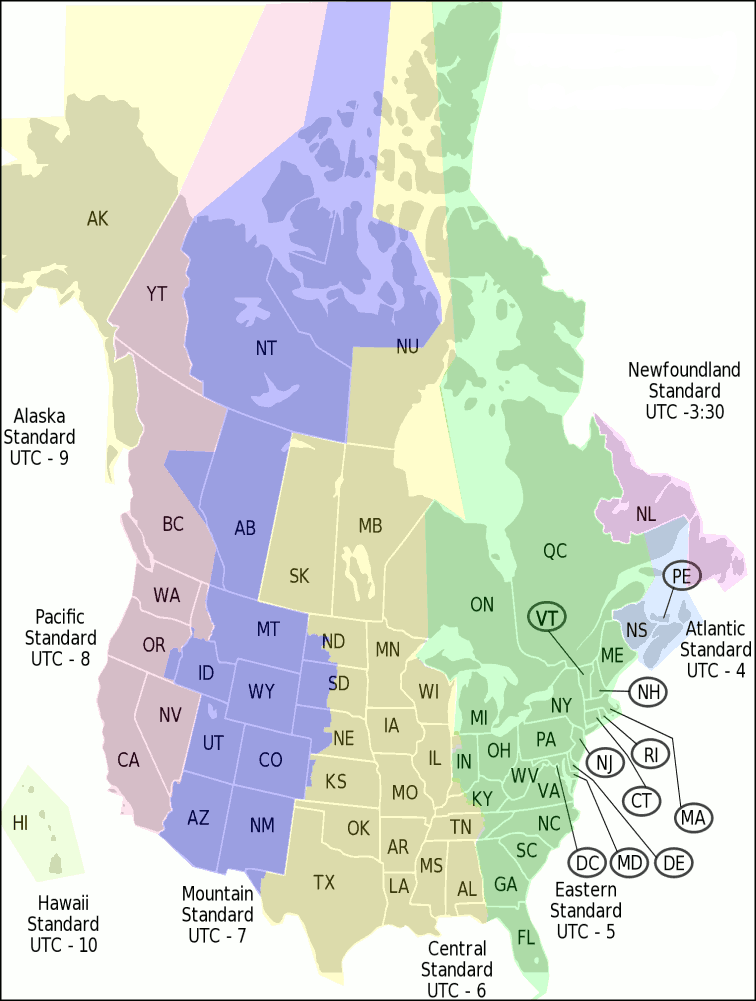
Atlantic Time observes standard time at four hours behind UTC (UTC-4), shifting to three hours behind (UTC-3) during daylight saving time. Standard time in the zone is based on the mean solar time of the 60th meridian west of Greenwich.
Atlantic Time (AT)
In the United States and Canada, the zone is commonly called Atlantic Time (AT) — specifically Atlantic Standard Time (AST) during winter, and Atlantic Daylight Time (ADT) during daylight saving time. A few areas within the zone, including the U.S. Virgin Islands, skip daylight saving entirely and keep Atlantic Standard Time year-round. In Canada, the provinces of New Brunswick and Nova Scotia sit within the Atlantic Time Zone, along with Prince Edward Island and small portions of eastern Quebec — the Côte-Nord region and the Magdalen Islands. Since 2007, the shift from AST to ADT takes place at 2:00 a.m. on the second Sunday of March, and the shift back to AST takes place at 2:00 a.m. on the first Sunday of November.
Daylight Saving Time in the USA and Canada
Daylight saving time begins at 2:00 a.m. on the second Sunday of March and ends at 2:00 a.m. on the first Sunday of November, in every USA and Canada time zone that observes it.
North America DST Change Dates
| Year | Begins | Ends |
|---|---|---|
| 2021 | Sunday, 14 March, 02:00 | Sunday, 7 November, 02:00 |
| 2022 | Sunday, 13 March, 02:00 | Sunday, 6 November, 02:00 |
| 2023 | Sunday, 12 March, 02:00 | Sunday, 5 November, 02:00 |
| 2024 | Sunday, 10 March, 02:00 | Sunday, 3 November, 02:00 |
| 2025 | Sunday, 9 March, 02:00 | Sunday, 2 November, 02:00 |
| 2026 | Sunday, 8 March, 02:00 | Sunday, 1 November, 02:00 |
| 2027 | Sunday, 14 March, 02:00 | Sunday, 7 November, 02:00 |
| 2028 | Sunday, 12 March, 02:00 | Sunday, 5 November, 02:00 |
| 2029 | Sunday, 11 March, 02:00 | Sunday, 4 November, 02:00 |
| 2030 | Sunday, 10 March, 02:00 | Sunday, 3 November, 02:00 |
| 2031 | Sunday, 9 March, 02:00 | Sunday, 2 November, 02:00 |
Daylight saving time begin and end dates in the USA and Canada.
North American Time Zones
The same eight time zones from the comparison above, organized by UTC offset instead of by name — useful for seeing which zones share a clock time once daylight saving time shifts them.
Time Zones by UTC Offset
| UTC Offset | Standard Time | Daylight Time |
|---|---|---|
| UTC-10 | Hawaii-Aleutian | — |
| UTC-9 | Alaska | Hawaii-Aleutian |
| UTC-8 | Pacific | Alaska |
| UTC-7 | Mountain | Pacific |
| UTC-6 | Central | Mountain |
| UTC-5 | Eastern | Central |
| UTC-4 | Atlantic | Eastern |
| UTC-3:30 | Newfoundland | — |
| UTC-3 | — | Atlantic |
| UTC-2:30 | — | Newfoundland |
Time zones in North America, by UTC offset.
GMT and UTC
Greenwich Mean Time (GMT) originally referred to mean solar time at the Royal Observatory in Greenwich, London. Coordinated Universal Time (UTC) is the modern, atomic-clock-based standard that has replaced it for precise timekeeping — but the two are close enough that they're used interchangeably in everyday contexts, including throughout this page.